Calculating Cutlery: Pt l


As any good caregiver will tell you, you quickly develop a second sense of your loved one’s state of mind after witnessing Alzheimer’s day in and day out.

You don’t have to be clairvoyant-just observant.

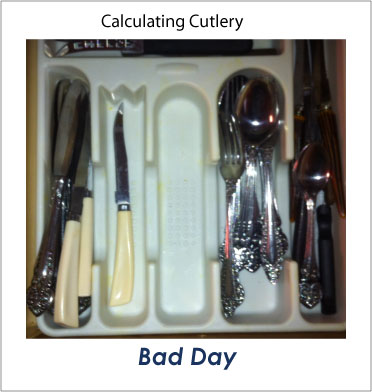
For example, I’ve learned that I can tell what sort of day I’m in for simply by looking into the cutlery drawer.

If, when I awake and go into the kitchen to make my coffee and look and see that the knives and forks are still in their respective slots in the tray (that I’ve returned them to the night before when I put away the dishes) then it’s probably going to be an easy day, a day where Miss Cathy is more or less self sufficient and not much is asked of me.

But, if I see that there is chaos and anarchy in the drawer; spoons and forks co-habitating and butter and steak knives fighting to occupy the same space then that’s a pretty good indicator that it’s going to be a long, long day.

At first I thought she was just ‘in a rush’ or ‘not paying attention’ and when I asked her about the mismatched cutlery she said she was “just being lazy” and would do better.

She was true to her word for a time but then she’d go back to making a mess.

This back and forth, with me playing “fork police” and Miss Cathy the “perp” went on for quite awhile. To the average person this may seem like ‘no big deal’ but caregivers get what I’m going on about.

It’s not the ‘mess’ (and no, I’m not comparing myself to Joan Crawford, as she was presented to the world by her victim-I mean ‘daughter’, Christina Crawford in the early 80’s biography and later cult classic “Mommie Dearest”, who happened to clean compulsively (usually three sheets to the wind) and clarify to her daughter after she’d dragged her out of bed in the middle of the night to help her clean that she wasn’t mad at ‘her’ (Christina) but that she was mad at the ‘dirt’).

No, this wasn’t about the mess, it was about trying to get a loved one with Alzheimer’s to try to ‘remember’ what they’d committed to doing and following through on a daily basis.

So, I try to use every little action or activity as a potential ‘teaching moment’ to help Miss Cathy learn to strengthen her memory muscle and challenge herself not to become mentally complacent.
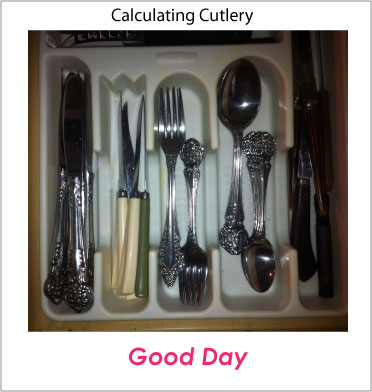
good-day

bad-day

Physician, Heal Thyself: Pt.Vl The Great and Powerful Dr of Alz


I quickly realized when I contacted the referral Dr GG; the Neuro-ophthalmologist gave me for Miss Cathy that this was not going to be a quick skip down the yellow brick road to a diagnosis.

First, I would have to deal with the “Program Manager” of the Clinic before I could gain access to the much sought after Dr Turner, Director of the Georgetown University Memory Disorders Program.

The Georgetown University Memory Disorders Program is dedicated to providing state-of-the-art clinical services for individuals affected by Alzheimer’s disease and related disorders and was conducting research aimed at improving treatment options for Alzheimer’s disease and that the Memory Disorders Program works in close collaboration with the ‘Alzheimer’s disease Cooperative Study’ to explore new clinical trials and receive updates about the current research.

I felt like Dorothy after she’d travelled so far and been through so much realizing that there was one more obstacle between her and whom she needed to see to get what she wanted when she arrived at the gates of the Emerald City.

Like L. Frank Baum’s most famous character, I had to get past the gatekeeper (or in my case, the program manager) in order to be granted and audience with the Wizard, I mean the ‘Doctor’.

Dorothy wanted to go home, I just wanted something holistic.

To my surprise and to her credit, the project manager returned my call just a few hours after I left a voicemail for Dr T (none of the ‘catch me, catch me’ games I’d played with other doctors recently).

She introduced herself and told me that she was the person who coordinated the schedule and screened potential patients for Dr T and the clinic. She then asked me to tell her about Miss Cathy.

She seemed sympathetic to my plight and listened intently as I told my tale, not saying much, occasionally interrupting me for clarification of a fact or two, which I took as a good sign that she may be interested.

After I finished she was very upfront and said that as distressing as the situation was to us, based on what I’d told her about mom’s condition, (the loss of vision and the increased confusion) Miss Cathy sounded as if she was presenting ‘typical’ symptoms consistent with her disease so she might not be a candidate for their clinic.
And even though the program manager’s assessment of our situation sounded like a rejection she didn’t say “no”, not just yet, so (in my mind) there was still a chance.

The more she talked, the more I wanted to get Miss Cathy an appointment with Dr T and into that clinic.

All I had to do was keep talking, and try to convince her to let us in.

As determined as Dorothy was to get what she wanted, I was just as determined and I knew there wouldn’t be any of those scary flying monkeys to deal with (I hoped).

So, (with one eye peeled skyward-just in case) I began my quest to get an audience with the great and powerful Doctor of Alz.

Physician, “Heal Thyself”: Pt. lVe Dr A


I know that I’m not trying to ‘play’ doctor.

I’m just trying to be an informed advocate for my mother. I also know that Dr A has tons of patients…good for him. I’m hoping he’s making buckets of money and buying more Ferragamo shoes.

But, I only have one (patient-not pairs of shoes) so Miss Cathy is my one and only focus.

“She came in saying that she could not see and that is what I am focused on.” Dr A said self-righteously during our telephone conversation.

“Yes, that’s true but when she came in I also told you that she’s confused and yes, I-know-that-having-difficulty-seeing-would-be-stressful-for-anyone but this is more than that, that’s why we came to you for help”, I said.

I could not believe I had to explain myself to this asshole.

The conversation continued (and believe me) it did not get much better. We agreed that she’d come back to his office in three days time and he would examine her again and explain the MRI results.

Interestingly enough I got a call the next morning from Dr A’s assistant telling me that he wanted Miss Cathy to go back to the hospital for an MRA (something he never mentioned during our ‘chat’ on the phone).

I had to wonder if my insistence on his doing something hadn’t prompted the additional brain scan.

Back in his office a few days later Dr A told us that (unfortunately) the MRA was just as inconclusive as the MRI so he said that he would confer with Dr S, the ophthalmologist.

I (unfortunately) had the same misfortune to spend several days leaving voicemail for Dr S (these guys must be reading from the same ‘script’) trying to follow up with him.

When Dr S finally retuned my call he told me that he never heard from Dr A (quelle surprise) but suggested it was time that I take Miss Cathy to (get this) yet another doctor (this one a “Low Vision Specialist”).

So, another appointment was made for a potential addition to Miss Cathy’s ‘team’ of doctors.

As for Dr A, it was becoming very clear what roles we each played in this little ‘doc’udrama.
And if you asked me (…and you didn’t but I’m gonna tell you anyway) Dr A seemed to be missing too many of his cues.

He may be the Doctor and I just the Son of the patient but I’m also Miss Cathy’s ‘Legal Primary Caregiver’ making me the Director of this little production.

And as the director I thought it was time (way past time in fact) to hold auditions and recast some one new into the role of Neurologist.

My Life Coach back in New York said to me many years ago, “If you don’t like the story that you’re telling, you have the power to rewrite it anytime you want”…and in this case that’s just what I intended to do.

Physician, #HealThyself: Pt. lVa Dr A, Neurologist


Dr A was the neurologist on call at Doctor’s Hospital where Miss Cathy was recovering after an accident in 2010. He was brought in the evaluate her after I noticed that she didn’t seem quite right even though the hospital was about to discharge her because she’d (luckily) not sustained any broken bones after her fall and her vital signs were all normal.

And sure enough, after a series of tests Dr A concluded that she had Dementia, Stage one Alzheimer’s.

I left my life to join hers soon after and became her primary caregiver.

It made sense to add Dr A to her ‘team’ of doctors since she was comfortable with him and he was the doctor that diagnosed her condition.

When I first met the doctor I took note of his professionalism, directness and knowledge of the disease (which at the time I only had a “Lifetime Movie of the Week” awareness of).

Once she was back home we saw Dr A at his private practice near her condo.

I was a fast learner and not just about the disease. One of the things I learned was that a doctor’s beside manner in the hospital is one thing and how he runs his practice to be quite another.

In time I became dissatisfied with Dr A and had to remember that I was the caregiver and not the patient. Miss Cathy by all accounts (and after direct questioning) was pleased with his care.

I had to remind myself of what one of best friends said to me early on, “Regardless of your personal opinions or feelings toward any of the ‘team’ all I have to do is collaborate with the doctors and get them to collaborate with one another”.

My friend stressed the word ’collaborate’ so many times that it’s all I can remember.

In my mind’s eye I couldn’t help but see the duck from the old Groucho Marx TV show drop down from the ceiling on a string with the word ‘collaborate’ written in block letters on a piece of paper hanging from it’s beak.

But, this was not some late night talk show with a panel of ‘B’ list actors from the Golden Age of Television and I was not a quick witted, Jewish comedian with a sight gag. I was dealing with a humorless doctor and a parent/patient that was content.

So, as the months turned into years and as the appointments with Dr A started to accumulate I started to question his methods and wonder if another neurologist could serve my mom better…or was this just about me and my ability to collaborate?

No matter, Miss Cathy was happy with Dr A, and in her eyes he could do no wrong…that was until a loss of vision caused her to see him in a different way.

Therapy Pt. lV: Alz R Us #EndAlz


Since Dr G’s referral for a therapist for Miss Cathy didn’t work out my next call was to Maureen Charlton, the Helpline Program Coordinator of the Fairfax, Virginia Alzheimer’s Association® National Capital Area Chapter.

The Alzheimer’s Association is a wonderful organization and I highly recommend them to anyone who has been touched by the disease. They have a wealth of resources and information.

The first thing I was grateful for was that they helped me to realize that I was not alone.

Their mission statement reads; “The Alzheimer’s Association is the world’s leading voluntary health organization in Alzheimer’s care, support and research”.

But (like everything in life) I have found it best not to depend on them completely and to think of them as just ‘one’ of your resources and not the ‘only’ one.

After talking to Maureen and explaining what I needed she emailed a list of doctors and therapists.

Unfortunately, as I learned a couple of years ago when I requested a list of ‘Elder Lawyers’ (no, not ‘old lawyers’, rather ‘lawyers’ that specialized in legal issues for the ‘old) I’ve learned that Alz.org’s information and referrals are not always up to date or current.

I found more than ½ dozen of the physicians on the list that she gave me for referrals was outdated.

Was I mad (no), did I get frustrated (yes) but considering the help that they’d already given me and the fact they were mostly a volunteer organization where everybody was doing their best I couldn’t ‘not’ cut them some slack.

Besides, they were kind enough to feature my journey with Miss Cathy as part of there “World Alzheimer’s Day Story Project” in 2011.

So, I took it upon my self to compile my own list of names that needed to be deleted from their list and emailed it to Maureen.

But, that still left me with more than enough professionals to contact so I got work.

As I worked my way down the list of doctors and therapist that were available to me I had to consider the very real possibility that this could all be a huge waste of time. I mean lets face it, I was looking for a therapist to help someone with problems that she might not remember having let alone remembering the solutions once she got up off the couch.

But, if Miss Cathy thought therapy might help then it seemed to me to be worth the effort to find her a good doctor, no matter the outcome.

Later that day I received an email from Maureen. She couldn’t have been more apologetic and wrote ”We do make every effort to keep our lists as accurate as possible, but as you can imagine, we cover a large territory and things change”.

She said that she was very appreciative of the info, but for me not to feel obligated, she knew that I had a lot on my plate already.

I wrote back that I knew they were doing their best and I was happy that I could help.

I just wanted to make sure that they updated their system so that another caregiver (or heaven forbid) a person with Alzheimer didn’t spend the day as I had trying to contact doctors that were either no longer in practice, had moved or in one other case needed to be removed for an entirely different reason.

http://www.alz.org/index.asp

Therapy Pt.lll: The Three “P’s” plus One


Even though I was perturbed, I’d not yet written off Dr G’s referral (but I was turned off by what I’d learned so far).

Before I dove into the mountain of paperwork required to see the doctor I decided to call back to ask what type of therapy the doctor practiced. When the person answering the phone couldn’t answer what I thought was a perfectly reasonable and simple question I tried to help her by asking, “Does he follow Freud, Yeung? Is he a Behaviorialist?”

You can’t really hear silence but it’s not like she was saying anything so that’s all there was on the other end of the line. When she did speak it was to mispronounce the names of the two long dead fathers of what we now call ‘talk’ therapy.

I went from being frustrated to disturbed that she couldn’t answer me.

But, realizing that she probably wasn’t get paid enough to know more than how to say “Doctor’s office” and “Please hold” I cut her some slack and asked if there was anyone else in the office who could help me.

So, using one of the skills she had at her command she put me on hold for a moment, after which another female voice came on the line and introduced herself as the office manager, understood that I had a question and asked if I could “please repeat the names I’d said earlier.”

“Sure”, I said and parroted my query.

“Fried?” “You who?” was her response and that pretty much told me all I needed to know (if not about the doctor, then about who he surrounds himself with and who he chooses as his representative to the unsuspecting and often unbalanced public).

“Umm,” she stammered, “I’m not familiar with those names she said, “but I think it’s the last person you said.’

“You’re the first person who’s ever asked that question. I’d ask the doctor but he’s in with a patient at the moment.”

“Think!…you think?!” I thought to myself. (Horrified) that she identified a type of thereapy that a doctor practices (behaviorism) for an actual person, I wanted to ask if she was pulling my leg but what I said was, “I think that’s all the information that I need, thank you.”

Setting aside the fact that she was the ‘office manager’ and the one person in the practice who should know the doctor’s credentials and methods I wondered, “Hadn’t she ever seen a Woody Allen movie or any Rom-coms based in New York City?”
They’re filled with therapist humor. Someone is always; either going to a shrink, making fun of shrinks…or is a Shrink.

I clicked off the line knowing that I wouldn’t be clicking on their website, wasting anymore of my time or printer paper anytime soon.

Update: I was later corrected by a clinical psychologist (who just happens to be a dear friend) who told me that the doctor I was referred to (and was asking about) was a “Psychologist and not a “Psychoanalyst” (a disciple of Feud) so I was asking the wrong question.

Okay…my bad, so the “Freud, Yeung, Behaviorist” query didn’t apply….but still?”

Not to absolve myself of my personal responsibility but shouldn’t they have known that I was barking up the wrong type of analyst’s tree?

Fortunately the following link can explain the Three ‘P’s” (The Psychiatrist, Psychologist, and Psychoanalyst) so that you don’t sound like me…the fourth “P”(a ‘Putz’) when you’re shopping for a therapist.

The Psychiatrist, Psychologist, and Psychoanalyst: The Differences Between the Three P’s

Therapy Pt. ll: #CyberPaperTiger


Our family meeting was on a Saturday so first thing the following Monday morning I was up early researching therapists to make Miss Cathy some appointments. The first call I made was to Dr G, her family doctor, he’s the doctor that’s known her longest and she respects the most.

Just like in business, it’s always smart to network with those that you respect and healthcare is no exception.

These days the instinct is to type ‘Therapist’ into Google but I think it’s best to have a referral (if possible) from a doctor who knows your loved one so that there is (hopefully) a personal connection when they are giving you a therapist’s contact information.

Unfortunately I did not feel ‘connected’ to the therapist Dr G recommended.

The therapists’ office was located nearby which is convenient but unlike in real estate it’s not just about “location, location, location”.

I’d called to set up a consultation with the therapist’s office and almost immediately I was turned off by the receptionist’s Priorities. She seemed to be much more focused with how the practice was going to be paid than with information about a potential new client.

Believe me, I know that the medical field is a business and everybody is out to “get paid” but can’t we at least have a modicum of pretense that it’s about the patient and not “the paper”?

The person that I spoke with also referred me to the practices’ website where “I” was to download, print out and fill out several forms to bring to the first meeting (information regarding payment-first and foremost).

While asking for a dossier (even before one sees a doctor) is quite common these days I just didn’t get a great feeling from the elitism of it all.

What if I didn’t own a computer, printer or have an Internet connection? Isn’t it awfully presumptive of a person’s status on the part of the doctor’s office?

And it’s not like we’re talking about making a ‘Ped’s’ appointment for a child here, this is an appointment for someone that’s almost an octogenarian.

Suppose Miss Cathy was the one calling to set up the consultation, can you imagine her trying to navigate the homepage, ‘clicking’ on links, going from ‘new patients’ to ‘forms’ to…well, you get the picture, besides, I don’t think mom has turned on a computer since she retired from the Veterans’ Administration back in Nineteen hundred and ninety three…enough said.

It just seems to me to be alittle insensitive for someone who supposedly specializes in geriatric counseling to put a 21st century burden on people born in the early part of the 20th century, is he a “Therapist’ or a ‘Cyber Paper Tiger’?

Sometimes all you can do is #laugh


“Can you come here for a minute?”

I heard the familiar refrain come from the direction of Miss Cathy’s bedroom the other morning as I got out of bed to greet a new day.

“I can’t even put my damn bra on!” She said with disgust.

Well, at least she’s not trying to put her tee shirt on as pants I thought to myself as I wiped the last of sleep from my eyes.

And sure enough, as I walked the few feet into her room my newly wakened eyes saw that her bra was not only on backwards…it was inside out as well.

It’s been about a month now since her step downward; it started with a loss of vision, compounded by confusion over the ability to see and use everyday objects. And now the simplest of tasks (things she’s been doing her entire life) have become complicated.

Watching her struggle with her under garment, as if someone had made an over the shoulder Rubik’s cube instead of a brassiere, looking nothing like the iconic Horst P. Horst photo of a woman caught in the act of snapping her brassiere, so famously paid tribute to in Madonna’s “Vogue” music video, Miss Cathy seemed as emotionally twisted as her bra straps.

She’d managed to put one strap up over her shoulder but the other was lost under a fold of skin in her armpit, somehow the back was in the front, the whole thing was inside out and the closures were pressed down on her breasts with the cups hanging off her back, looking about as useful as tits on a bull.

“How in the world?” I started to say, then I had to laugh and so did she.

“Damn!” she said between chuckles as I gently unhooked the closures, releasing her ample bosom, taking the garment off her to reconceive it for its intended purpose.

“All these damn titties!” She said looking down at herself and talking as if she were divulging a secret her body was not aware of.

“I hate these fuckers!”

“Well” I said giggling, helping her to put her brassiere on correctly.

Nothing like seeing an old lady topless, especially your mom, first thing in the morning to let you know what kinda day you’re in for.

“Put you boobs away.”

“I wish I could cut ‘em off! I hated them even when I was a girl and they first started growing. I know men are suppose to like’m.” She said, arranging herself into her bra.
“I wonder what they’d think if they had them instead of balls and they had to lug’m around all the time.”

I helped her snap shut the last closure in the back the helped her with put on her top tehn said, “I’m sure if they had tits and no balls they’d think they were women.”

….more laughter.

# Physician, “Heal Thyself”: Pt. l


I have always had a great respect for doctors.

Growing up I spent (more than) my fair share of time in hospitals, as well as an adult (for various reasons and relations). I do not have a fear of doctors or hospitals. If anything I feel quite at home among the chaos, quiet, and antiseptic smells mixing with life, death and uncertainty.

So, with my comfort in and respect for the medical profession, I find it interesting that after all of these years I’m still not so sure how the professionals feel about me.

While it seems that doctors (mostly….well, ‘almostly’) tolerate an inquisitive patient, someone who is actually participating in their own health care by asking questions, challenging their doctor to explore options for treatment, etc, it’s different when you are the caregiver for the patient.

Doctors’ reaction to and engagement with me since I started taking care of Miss Cathy have run the gamut from A to Rx.

My routine has been that when I accompany her to see one of her doctors I always take her meds and my composition book to take notes. I sit in the room with her and try not to interrupt or interject unless I’m asked a question directly or need to clarify something that’s she’s said in error.

Lately, l’ve started taping her meetings with my iPhone a) to refresh my memory and 2) to have proof of what went down during the appointment if/when I’m challenged on something that was or wasn’t said while with a doctor.

In the last ten days Miss Cathy and I have been to see her ophthalmologist and her neurologist. She’s had an MRI, MRA and is scheduled for a Diabetic Retinopathy to help explain her recent loss of vision and (ongoing) confusion.

So far there seems to be more questions than answers…but not to worry, I’m taking notes.

The other #”F” word: Pt lll


Back in 2010 when it was discovered that Miss Cathy had first stage Dementia with an Alzheimer’s diagnosis, I asked Dr Alemayehu, her neurologist what to expect.

He said something to the effect that “each patient is different and their mental faculties diminish differently at varying rates, some deteriorate rapidly while others can remain relatedly stable for years ”. What I remember most clearly was that he sounded about as matter of fact and dry as if he were talking about actuarial tables.

He couldn’t and wouldn’t give me a timetable for progression of the disease (and rightly so). The control freak and planner in me would just have to sit tight.

As my mother used to say, “You can’t set your clock by crazy”.

It was going to be a game of ‘hurry up and wait” (for what who knew and how much care she’d need was a question mark). There’s not much one can do to prepare except avail oneself of books, support groups, websites, et al so that’s what I’ve been doing.

Then, that day not long ago, the clock chimed ‘Koo-coo” and the alarm bells in my head went off, time to put all that ‘book learnin’ and research’ to use.

The slide downward had begun again and it was obvious that the doctor was right; her disease was just on holiday….much like I was.

It’s not like I thought there was a “sell-by” date on Miss Cathy’s sanity but I couldn’t help but be surprised when the time came and things started to change.

I found that I’d started to live day to day much like the characters in the movie “Groundhog Day”, on a calendar that doesn’t change and if/when it does its only toward a future grounded in the past.

I’ve also realized that caregiving is a marathon and not a sprint.

Unlike a disease where you can have a nice hospital stay where friends and family can come visit to feel better about themselves (in-patient treatment for Alzheimer’s is few and far in between-and are usually the result of a fall or some other by-product of the disease) or get an operation for a cure (there isn’t one) or take a pill to put your illness in remission (it doesn’t exist).

So, it’s not about the ‘quick fix’ because there isn’t one, buying a helium “get well soon” balloon is well intended but not what’s needed to tend to your loved one’s well being.

It’s about living close (or in close proximity) and day to day care, teaching the same things over and over, aiding and guiding your loved one through simple tasks that they’ve performed thousands of times before but now are as foreign to them as you will one day become.

It’s also about being available 24/7 for comforting and empathizing, explaining the same questions and correcting the same mistakes again and again, day after day, after day.

So, Miss Cathy and I are joined, hand in hand, walking through the valley of the shadow of decline.

For her, the loved one, the one with Alzheimer’s, her “F” word may be “Forgetting” and, for me, the caregiver, the one that has chosen this journey my “F” word may be “Frustrating”.

But, at the end of a long day, when your loved one is tucked away, and there is peace and quiet in the home, one might just think of the other “F” word……“Faith”…….faith in the knowledge that tomorrow is a new day, and with your loved one, a new chance wipe the slate clean and to start again.

Postscript: Since this posting Miss Cathy has undergone an MRI (which was non conclusive) and is scheduled or an MRA and a Diabetic Retinopathy while her ‘team’ continues to find an answer for her sudden loss of vision.